
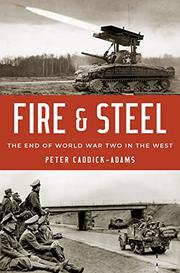
Caddick-Adams covers the 100 days from late January 1945 until May 8. He begins by arguing that many accounts of the war in Western Europe focus too heavily on D-Day, the summer battles in Normandy, and the Battle of the Bulge. “Like a movie suddenly speeded up,” historians treat this period as an anticlimax. “Once across the Rhine,” writes the author, “the advance into Germany of March-May often passes in a few paragraphs, with the end seemingly predetermined, and it only remained to occupy territory and mop up a few diehards.” In his first anecdote, Caddick-Adams illustrates this error. In mid-March 1945, more than 600 American soldiers crossed into Germany and alerted the enemy by stumbling into a minefield; 456 became casualties or prisoners. Having recovered from the Battle of the Bulge, the Allies pushed into Germany, which meant confronting the Westwall, a defense line that “comprised more than 18,000 bunkers and stretched four hundred miles from Holland to the Swiss frontier.” Although it was a formidable defense, Caddick-Adams points out that fixed defenses “cannot halt an opponent unless fully manned and infinitely resourced.” In 1945, the Wehrmacht consisted mostly of burned-out veterans and poorly trained, dispirited replacements. Many historians emphasize their eagerness to surrender, but Caddick-Adams points out that a few disciplined German units maintained a powerful resistance until the end. The author divides the campaign into three parts: conquest of the Rhineland (a brutal business), the effort to cross the Rhine (mostly through good luck and massive resources), and the race across Germany (easier than the previous two but never a walkover). Caddick-Adams includes vivid anecdotes, small-unit fireworks, and strong, well-informed personal opinions on the often unwise decisions of leaders. He also recounts mass movements that require close attention to his maps and dutifully records more names and nicknames of smaller units and their commanders than general readers require.
Source:kirkusreviews
Comments
Post a Comment