
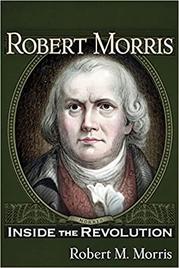
The subject of this book was once “seen as the equal to Washington and Franklin; but now he is barely remembered, if at all.” In these pages, the story of Robert Morris, who signed the Declaration of Independence and helped finance the American Revolution, is told. Morris was born in England in 1734. He came to Philadelphia as a teenager and went to work for Willing and Company as a clerk. At the time, the city was “the hub of a dynamic market,” and Morris learned to excel in trade. By the age of 22, he became a supercargo, a representative of the ship’s owner, on Willing vessels. This position had him conducting transactions in foreign ports and managing finances for merchant voyages. He might have spent many years as a successful, wealthy Colonial businessman if war with England hadn’t broken out. Although by the mid-1770s Morris still hoped for a peaceful resolution with Britain, this was not to be. And the rebel effort needed money. This was no small feat; Morris “had much to lose by working with the rebels, however he had given his word, so he used his most persuasive techniques to convince other people to aid the effort.” Despite his assistance to the winning side, the postwar years were not particularly kind to Morris. He spent time in debtors prison. Later, he died “in obscurity” in Philadelphia in 1806.
This ambitious volume makes quite clear that the situation in the Colonies in the late 1700s was hardly a united front. In addition, there were huge monetary concerns. From supply-chain issues to the constant need for war funding, the rebels faced seemingly impossible odds before independence was won. Take, for instance, how the “Continental Congress declared bankruptcy in March 1780 and devalued the currency at the rate of 40:1.” Yet the most vivid and tangible points in the work come from Morris’ own papers. Many telling excerpts are included. Morris wrote to a friend quite clearly about how during the war he at times “made immense sums and at others lost them again for the whole was a lottery as we could not get insurance.” He explained that in debtors prison, “the pen is my own; that and the clothes I wear are all I can claim as mine here.” Readers will come to feel great sympathy for the man. But at over 600 pages—which include occasional illustrations by various artists—this book by author Robert M. Morris (a descendant of the book's subject) offers readers a lot of details to process. Not all of it is thrilling. Topics such as payments for post office officials and squabbles with the government of Pennsylvania can prove dull even for the most dedicated history buffs. Nevertheless, readers will get a cogent, complex look at the American Revolution that goes beyond names like Washington and Franklin. This highly informative work profiles a man who risked everything to play an important part at a crucial juncture in the founding of America.
Source:kirkusreviews
Comments
Post a Comment